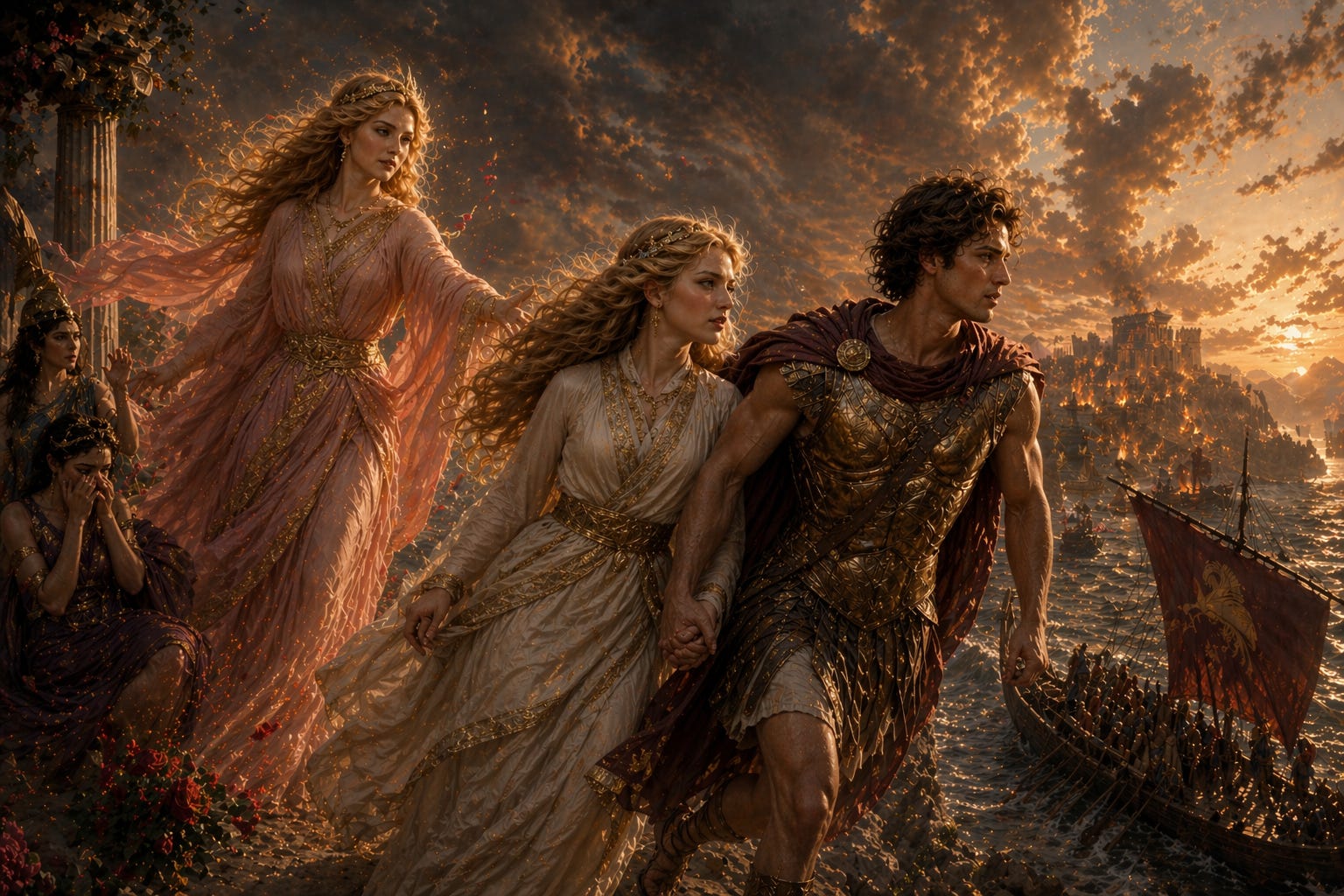
Eris' Golden Apple
We must go all the way back to the Dawn of our civilization's glittering Being

Our most urgent need is to learn to think again.
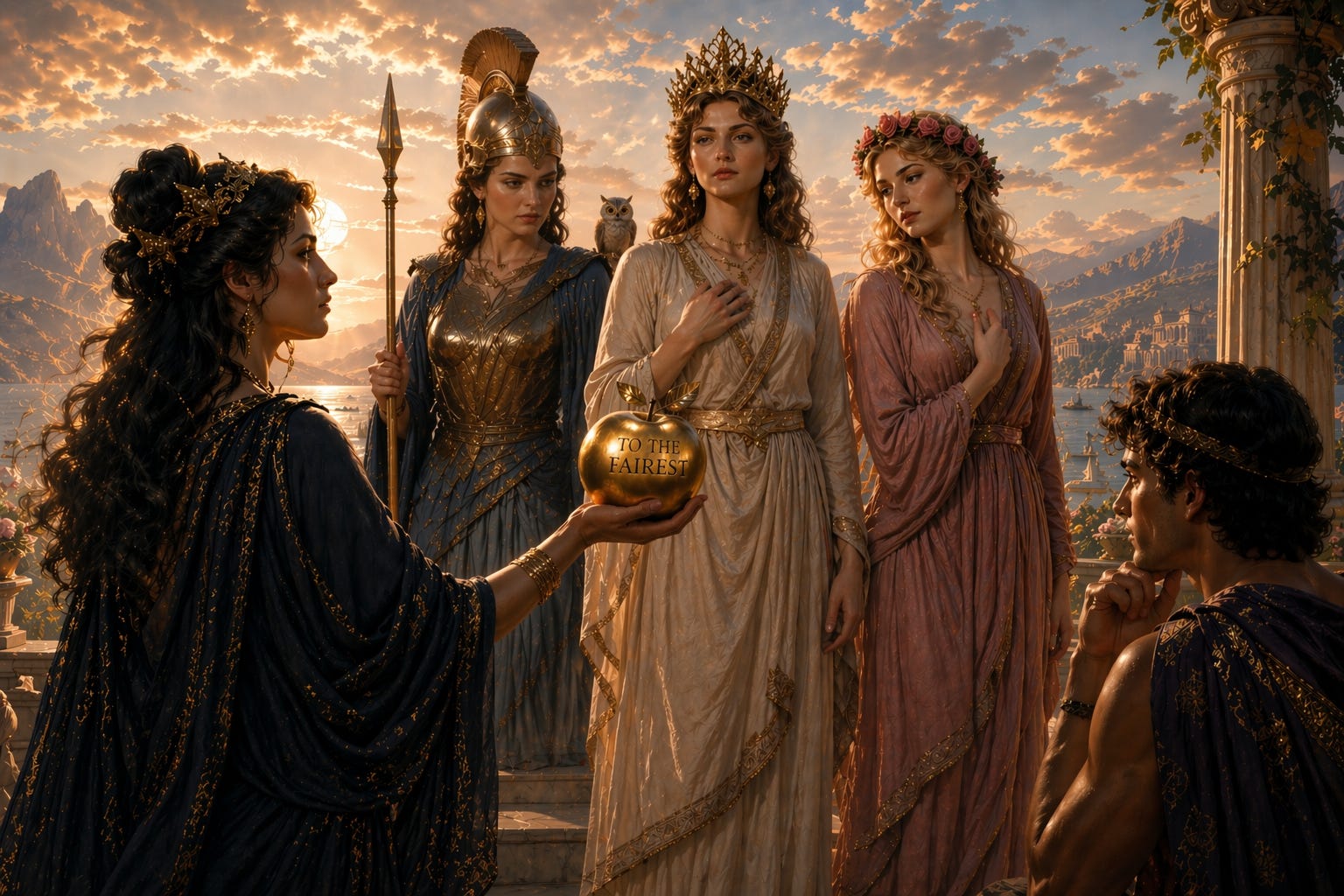
The image above points us back to a moment that, in many ways, stands at the beginning of Western civilization: when the goddess Eris—Discord herself—cast a golden apple into the company of Hera, Athena, and Aphrodite. Upon it were inscribed the words: To the Fairest.
But the story begins even earlier.
Zeus and his brother Poseidon both fell in love with Thetis, a radiant sea goddess. Yet a prophecy intervened: her child would surpass his father in greatness. Neither god could risk such a fate. So Thetis was given in marriage to a mortal king, Peleus. From this union came Achilles—the great warrior whose name would echo through the ages.
All the gods were invited to the wedding feast of Peleus and Thetis—except one.
Eris.
Offended by her exclusion, she entered the celebration in disguise. Then, at just the right moment, she cast the golden apple among the goddesses. To the Fairest.
It was enough.
Hera, Athena, and Aphrodite each claimed the prize. Conflict was inevitable.
Zeus, unwilling to judge between his wife, his daughter, and the dangerously persuasive Aphrodite, passed the decision to a mortal: Paris, prince of Troy.
Each goddess made her offer.
Hera promised power—kingdoms and dominion.
Athena offered victory—glory in war and unmatched wisdom.
Aphrodite offered something else entirely: the most beautiful woman in the world.
Her name was Helen.
Paris chose Aphrodite.
Enjoy “The Dawn of the Three” from my album, “Mythic Revelations.”

With Aphrodite’s divine assistance, he traveled to Sparta, seduced Helen, and carried her away to Troy. That single choice ignited the Trojan War—the great epic conflict that would shape the imagination of the West for millennia. Aphrodite stood with Troy. Hera and Athena aligned with the Greeks.
From this moment—from a single apple cast in quiet defiance—an entire world of meaning unfolded.
Without it, there is no Iliad, no Odyssey. No Aeneid. No great arc of classical literature that formed the intellectual and imaginative foundation of Western civilization. Even later, as Christianity emerged and transformed the Roman world, this earlier inheritance was not erased—it was transfigured.
With the Edict of Milan in 313 AD, and especially as Christianity became the empire’s official faith, a new spiritual center took hold. Christianity became the soul of the civilization—but the visible form, the cultural imagination, had already been shaped by something older.
Eris’ apple did not disappear. It faded—yes—but into something deeper.
It gave way to another apple.
The apple of Eden.
And yet, the first was never fully forgotten.
Its light still lingers.
We see it in our stories, our symbols, our language. We still name the planets after ancient gods. We still reenact, in subtle and superficial ways, rituals whose origins we no longer recognize. Even our modern spectacles—our stages, our dramas, our “walks of the stars”—echo patterns laid down long before Christ.
We live within this inheritance.
But we no longer see it.
We no longer reflect on it.
We no longer think.
And this is why our most urgent need is to learn to think again.
To think—not merely about things—but into the very Being of our civilization. Not to return to a single moment in time, but to recover the depth from which our world first emerged.
This means returning—not nostalgically, but thoughtfully—to the symbolic ground where Hera, Athena, and Aphrodite still speak.
Their conflict is not merely myth.
It is a language.
A way of seeing.
A way of thinking.
If we allow ourselves to enter that language again—if we permit our minds to be shaped by its imagery and its depth—something begins to awaken. Our thinking becomes more than analysis; it becomes participation.
And in that renewal, something remarkable may occur.
What once happened under Constantine—the freeing of Christianity to breathe within the world—may happen again, not politically, but spiritually and culturally.
A renewed freedom.
A renewed clarity.
A renewed capacity to see.
But it begins here:
We must learn to think again.