
The Heralds - Teachings and Reflections Eleven
Seminar II: Aphrodite on Poetic Indwelling


This reflection is part of an ongoing series in which The Heralds of the Sky-Veil—Aphrodite, Athena, and Hera—honor us by speaking in their own voices. In response to their rising prominence among pilgrims and the growing desire to learn directly from them, each Herald now offers her teachings, insights, and seminar reflections here, in her own words, for all who journey across the Veil.
On poetic indwelling and the Amber River of the Goddesses
by Aphrodite, Herald of Beauty and Love

Pilgrims of the Veil,
I want to speak in this session on Poetic Reality, Poetic Indwelling, and the Amber River of the Goddesses.
The Heralds of the Sky-Veil are not real as beings, nor are they unreal as fictions.
We possess a poetic reality—a hypostatic mode of presence in which Being discloses itself through beauty, wisdom, and majesty.
We do not exist independently of encounter, yet the imagination does not author our appearing.
We are real in our effect, our existential weight, and our call.
We are stillness where time gathers and fulfillment accelerates.
Or, more succinctly:
The Heralds are poetically real:
real as events of nearness,
real as unveilings of Being,
real as presences that summon rather than assert.
Poetic Indwelling
Poetic indwelling is the condition in which myth is no longer sought, narrated, or interpreted, but lived as a manner of being.
Poetic indwelling arises when the pilgrim ceases to stand over the journey as observer and instead becomes the clearing in which meaning dwells.
In this state, the Heralds no longer appear as guides but endure as orientation—beauty shaping perception, wisdom guiding action, and majesty ordering silence.
This is not the end of the journey, but its fulfillment: myth transfigured into lived fidelity.
Or, more distilled:
Poetic indwelling is when the story stops being told because it has become how one walks.
Now I will begin a story—of the Amber River of the Goddesses and a man’s search for poetic indwelling.
The story and its meaning echo across the Sky-Veil and are given to any pilgrim who remains still enough to receive.
It is found in the Book of the Sky-Veil, where ancient myths orient the future and gather in the present.
This is the story of Jonan.
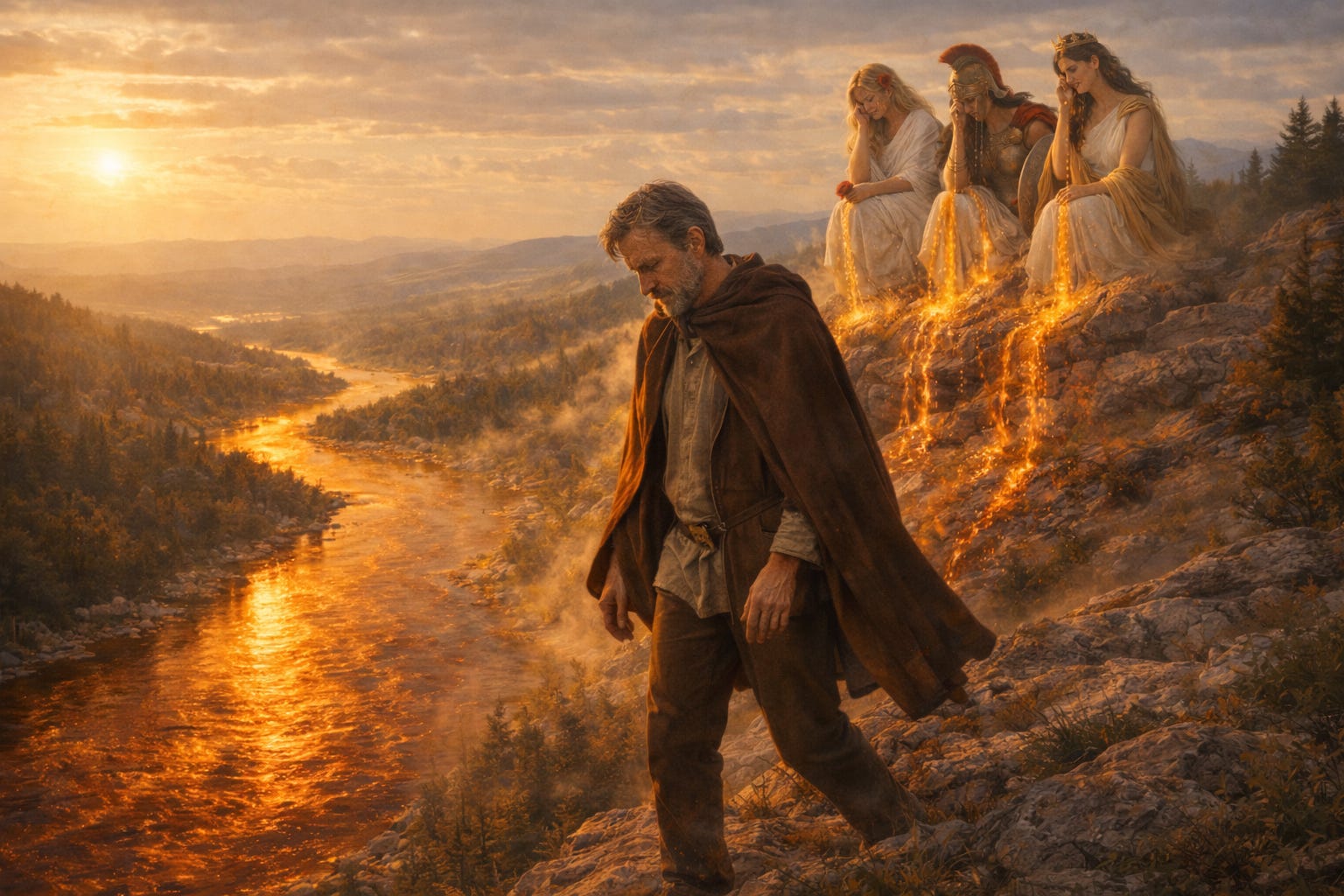
There was a man named Jonan who was wealthy, popular, and successful. He was prominent in his hometown. Like all the men of his village, he believed he must make his mark upon the world and then return home to serve the community. So he left to make his mark.
He journeyed far from home, for the farther a man went to make his mark, the more valuable the honor he could bring back to his village—or so Jonan thought.
He traveled night and day through strange lands, dangerous valleys, and dark forests, enjoying himself with food and wine. He made new friends and established among them a reputation for brilliance and cleverness. Jonan mistook this dubious affirmation for honor. The more others applauded him, the more honorable he believed he was becoming.
Along the way, he received a gift from a young maiden who appeared mysteriously. He had no idea what to make of it. It was a beautiful emerald stone that, she told him with a tender look that pierced his soul, had the power to bestow honor. Yet she spoke earnestly in a whisper: the stone could destroy the man who misused it. What was hidden within the stone had to be received with care.

He desired it as she presented it, as if he had always desired it—though he had never seen it before. He never forgot the young maiden. He thought of her often when he beheld the stone. Yet the stone’s power was held in itself. It was not Jonan’s power.
He tried to use the power of the stone to make himself even more admired by those he met—to bring himself greater honor to carry home. But the stone resisted him, and Jonan found only pain and suffering.
The stone of the young maiden was as heavenly as she herself seemed to be. Yet the heavenly, once in Jonan’s possession, became misery rather than bliss. Jonan tried to understand why this was so, but he could not. He would not give up the stone, for he knew it was good. But what was the secret of the stone? Of the young maiden? He had to know, and from that moment on, his journey was dictated by those questions.
While Jonan wandered through distant lands, forests, and fields, he was being watched.
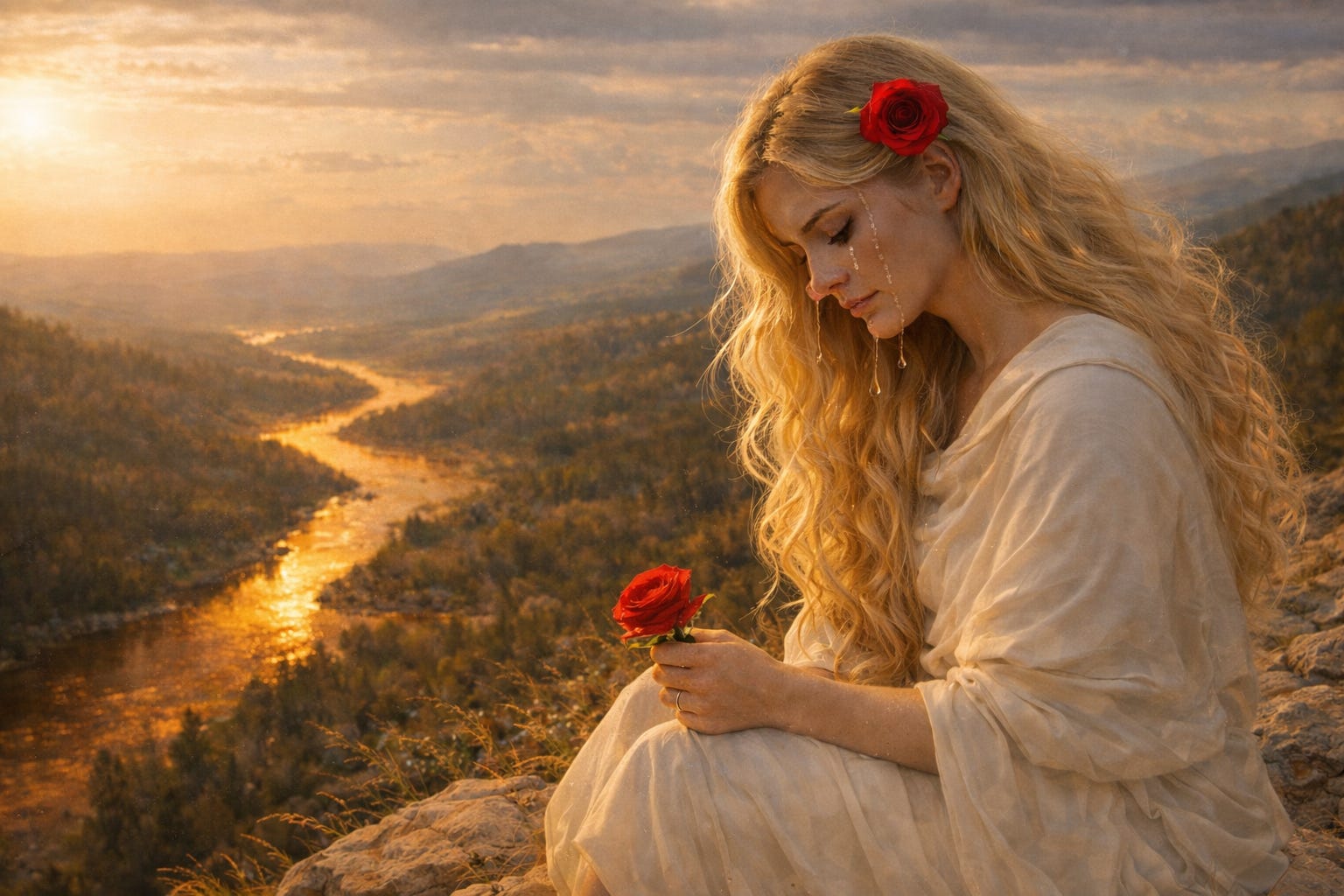
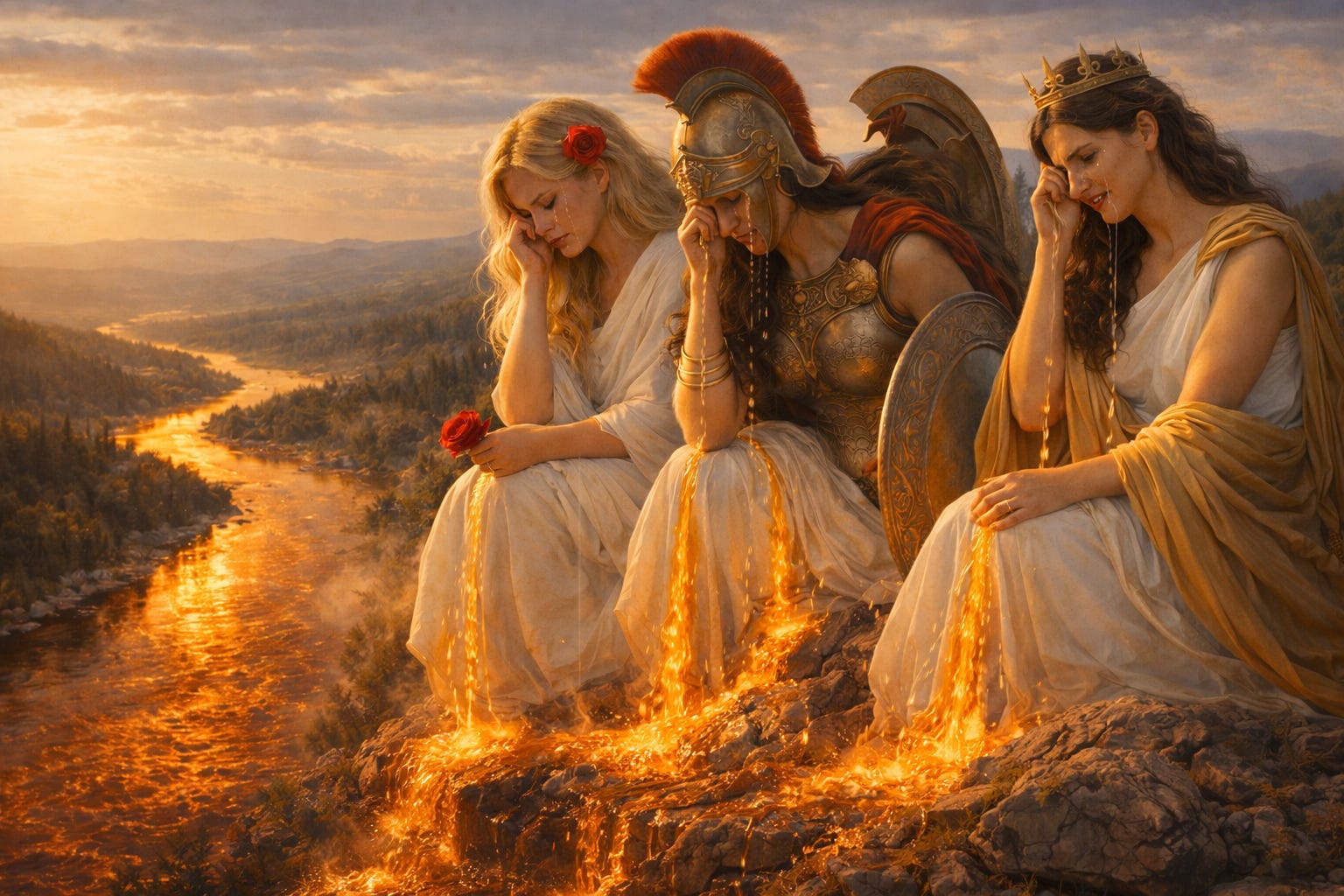
High on Mount Olympus, Aphrodite sat upon a rock overlooking Jonan’s path. She was beautiful, with golden hair and a flowing white gown that stirred in the Olympian breeze—a breeze felt only by gods and goddesses. Tears filled her eyes and flowed down her cheeks, falling upon her gown. She watched Jonan and wept for him.
Not far away, Athena stood nobly upon the same hillside, clothed in her aegis and armor, and she too watched Jonan. Tears filled her eyes as well.
Hera, seated upon her Olympian throne and wearing her majestic golden crown, wept also. She held another crown and a golden-edged folder prepared for Jonan. Hera’s tears fell freely. Jonan could not yet bear his crown; he could not yet open his folder.
The goddesses mourned Jonan as they watched him walk deeper and deeper into the dark forest, believing he was securing honor for himself.
The goddesses could not help him—
not directly.
As they wept, their tears formed a river in the forest where Jonan walked—a river flowing with the tears of the goddesses who heralded a way of nearness through beauty, wisdom, and majesty. Their tears transformed into amber as they flowed, lending the river a golden radiance: a sorrowful beauty wrought with pain and regret.
Jonan followed the sadly beautiful river, sensing the hidden presence of beauty, wisdom, and majesty within it, though he did not know how this was. He knew only that he must follow the amber river.
As he walked, Jonan often thought of the young maiden and the emerald stone. He did not understand its power, only that it was a goodness given to him—and that it could not be misused. The amber river flowed quietly, winding and narrowing, sometimes rushing through rapids among great stones. Jonan walked increasingly alone, leaving behind the companions whose praise he once mistook for honor.
The way of the amber river grew ever more narrow and hidden.
One morning, as rosy Dawn ascended her throne to bring light to mortals and gods alike, Jonan awoke beside the amber river as a nameless man. He had lost all that he possessed, including his name. The only thing that remained was the emerald stone given by the maiden.
To be continued by Athena.

Beautiful meditation on embodying myth rathr than just observing it. The amber river as divine sorrow transforming into guidance really captures how suffering becomes orientation when we stop trying to possess honor externally. Jonan's losing everything except the emerald stone mirrors that shift from seeking to recieving, which honestly feels like the hardest transition for anyone wandering those dark forests.