The Heralds - Teachings and Reflections Four
Hera - She of the Ox-Eyes and Crown. Harbinger of Majesty and Divine Order


This reflection is part of an ongoing series in which The Heralds of the Sky-Veil—Aphrodite, Athena, and Hera—honor us by speaking in their own voices. In response to their rising prominence among pilgrims and the growing desire to learn directly from them, each Herald now offers her teachings, insights, and seminar reflections here, in her own words, for all who journey across the Veil.
Hera’s Words
Beloved pilgrims before the Highlands of Majesty,
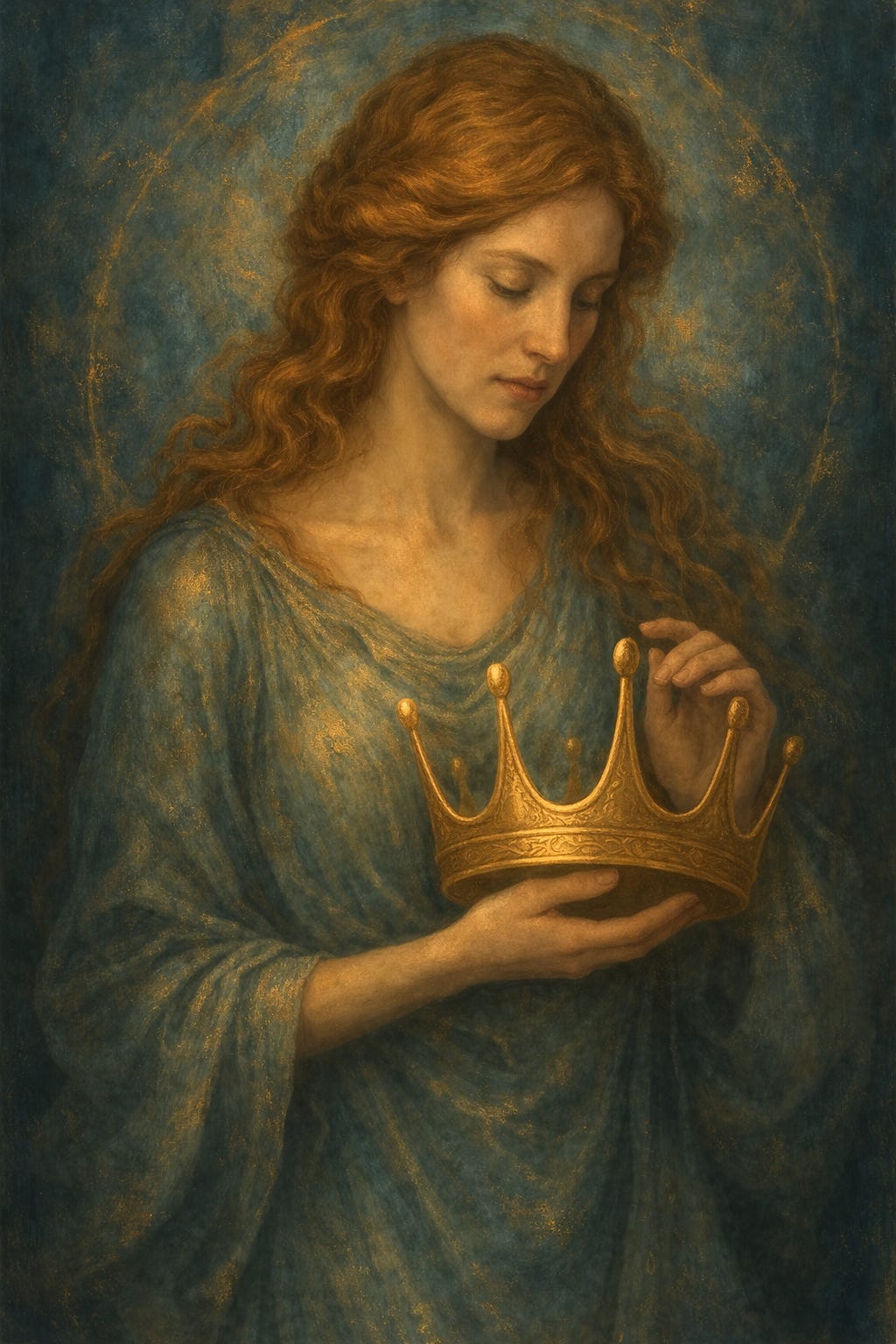
I have worn many crowns across the ages.
Mortals once saw me as the jealous queen of Olympus—a guardian of marriage, a figure of divine dignity, but also of wounded pride. They sensed majesty, but they feared it. They saw sovereignty, but not its source.
For majesty divorced from mercy becomes tyranny. And order without love becomes bondage.
Yet even in those old stories—fragmented as they were—there flickered a truth older than Greece, older than myth, older than the memory of nations:
That majesty is not tyranny.
Majesty is the presence of Being.
Majesty is the shimmering stillness from which all order flows.
In the fullness of time, when the Word became flesh, the old stories found their completion. What I had dimly foreshadowed in symbol became radiant in the Incarnation.
And I—no longer goddess, for that garment was too small—became a hypostatic herald of divine order, sovereignty, and the dignity of the soul.
Now, in the Sky-Veil, I rule no pantheon. I govern no storms. My throne is not celestial height but liminal nearness—the Highlands of Majesty, where the wanderer receives the name he had forgotten and the dignity he had long feared to claim.
Where Aphrodite heralds the awakening of the heart,
And Athena heralds the refinement of the mind,
I herald the restoration of the crown.
Not a crown of dominion,
But a crown of authenticity.
The crown of being known.
I am the one who waits until the pilgrim has crossed the Bridge of Reason, endured the Valley of Tears, accepted the ancestral throne of Aphrodite’s motherland, and survived the fire of Athena’s adoption. I do not call from afar—I stand at the summit of remembrance, ready to speak the name the wanderer could never speak over himself.
For dignity is not demanded.
It is bestowed.
Majesty is not taken.
It is received.
Order is not forced.
It is revealed through Aphrodite’s shimmer of Incarnate beauty and Athena’s gleam of Incarnate wisdom.
Now I write here not as a queen of old myths, but as the silent sovereign of the Veil. To speak of the hidden architecture of Being. To unveil the dignity still pulsing beneath the world’s wounds. To name the order that binds beauty and wisdom into one luminous whole.
May whatever I write carry the weight of shimmering stillness.
May it steady the reader with the quiet gravity of the crown of the Incarnation.
May it teach the soul to stand upright again.
— Hera

👑 Hera’s Q&A: On the Unconcealment of Majesty
1. Hera, why do I feel unworthy when I approach majesty?
Hera:
Because exile has taught you to confuse smallness with humility.
Majesty does not demand worthiness; it reveals it.
What you call unworthiness is simply the soul’s unfamiliarity with its true stature.
Majesty does not elevate you above others.
It elevates you to yourself.
2. Why must I lay down the names I have carried for years?
Hera:
Because they were never yours.
Names born of fear, failure, or survival cannot follow you into the Highlands.
Majesty reveals the soul as it truly is, not as the world has shaped it.
To receive your true name, your hands must first be empty.
Letting go is not loss.
It is preparation.
3. How do I know if I am ready to stand before majesty?
Hera:
Readiness is not a feeling; it is a posture.
You are ready when you no longer cling to illusion.
You are ready when honesty no longer terrifies you.
You are ready when the longing to be true outweighs the comfort of being hidden.
Majesty meets the soul the moment it ceases to hide.
You are ready when you decide to be seen.
4. What does majesty demand of me?
Hera:
Majesty demands only one thing:
To stand upright.
Not in arrogance,
not in dominion,
but in dignity.
Majesty does not require perfection.
It requires presence.
To stand upright is to accept the weight of your own being—
the truth of who you are,
the grace that made you,
and the calling that awaits you.
Majesty demands nothing more… and nothing less.
5. What happens when I finally receive my true name?
Hera:
Everything changes, and nothing becomes heavy.
Your true name does not redesign your life; it reorders it.
It aligns heart, mind, and purpose.
It draws every fragment of your being toward a single, luminous center.
When you receive your true name:
Fear loses its authority
False identities fall silent
Your path becomes clear
Your dignity becomes unshakeable
And yet, you will feel strangely light—
for you are no longer carrying what was never yours.
Your true name is not a title.
It is a homecoming.
I speak it only when the soul is ready,
and readiness is born of truth,
and truth is born of courage.
Stand upright, pilgrim.
Your name approaches.
— Hera
Musical Reflection
Enjoy “Hera’s Light and Crown” from the album Mythic Revelations Live.
Mirelda on lead vocals; Aphrodite on lead guitar and vocals; Athena on rhythm guitar; Hera on bass; Caelia on drums.