The Heralds - Teachings and Reflections Twelve
Seminar II: Athena on Poetic Indwelling


This reflection is part of an ongoing series in which The Heralds of the Sky-Veil—Aphrodite, Athena, and Hera—honor us by speaking in their own voices. In response to their rising prominence among pilgrims and the growing desire to learn directly from them, each Herald now offers her teachings, insights, and seminar reflections here, in her own words, for all who journey across the Veil.
On poetic indwelling and the Necessary Passage
by Athena, Herald of Wisdom and Clarity

Pilgrims of the Veil,
You have heard from Aphrodite of poetic indwelling—how Being draws near through beauty, and how the pilgrim is gathered into its call. I will speak now of what follows. For many who are drawn by beauty do not yet dwell within it. They seek to understand what has already begun to claim them.
They follow the trace. They name the pattern. They listen for coherence beneath what they feel. This is not error. But neither is it fulfillment.
On the Nearness That Cannot Be Mastered
When poetic indwelling first touches the pilgrim, it does not arrive as clarity. It arrives as disturbance, depth, a quiet that exceeds the one who hears it
The mind, faithful in its task, begins to respond. It gathers. It compares. It seeks to order what has been given. And in doing so, it brings the pilgrim far. But only so far.
The Limit of Interpretation
There is a threshold beyond which thought cannot proceed by its own light. Not because it fails—but because what it encounters is not its own to resolve.
At this threshold:
meaning is no longer constructed
presence is no longer inferred
the pilgrim no longer stands over what is given
He or she stands within it.
Poetic Indwelling
Poetic indwelling does not occur when the pilgrim understands the journey. It occurs when understanding yields, interpretation quiets, and the one who seeks becomes able to receive. In this way, poetic indwelling is not the triumph of thought—but its transformation.
Or, more succinctly:
Poetic indwelling is not when the pilgrim sees clearly. It is when he no longer insists on seeing by his own light.
The Necessary Passage
Between being drawn and truly dwelling, there is a passage that cannot be avoided. In this passage the mind reaches its height and discovers its limit. What has been followed as feeling becomes inquiry. What has been held as meaning begins to open. And what was thought to belong to the self is revealed as something other.
The Listener at the Threshold
Many arrive here and remain. They become refined. Perceptive. Attentive to the movements of the inner life. They map what they encounter with great care. And yet—they do not cross. Not because they refuse, but because they do not yet see that there is something to receive.
The Turn
The passage into poetic indwelling begins when the pilgrim asks—not with certainty, but with openness:
What if this is not mine?
In that moment, the direction of the journey changes. No longer from the self outward but from what is given inward.
The Story Continues
The man of whom Aphrodite has spoken has been drawn, wounded, and emptied. He has followed the amber river of the goddesses and has awakened without a name.
He now stands at the threshold where understanding reaches its end and something else begins. Here, he will encounter one who has come as far as thought can lead.
She listens.
She reflects.
She discerns.
But she does not yet receive.
I will now continue his story.
One morning, as rosy Dawn ascended her throne to bring light to mortals and gods alike, Jonan awoke beside the amber river as a nameless man. He had lost all that he possessed, including his name. The only thing that remained was the emerald stone given by the maiden.
He did not rise at once.

The river, which had once rushed and wept beside him, now moved more quietly, as though its sorrow had deepened into something still and watchful. The amber glow remained, but softened—no longer calling him forward with urgency, but surrounding him with a gentle and unspoken nearness.
He placed his hand upon the earth. It felt… real in a way he had never known before, as if given and not merely present. He did not understand this. He no longer tried. It was then that a subtle shifting in the stillness made him aware that he was not alone.
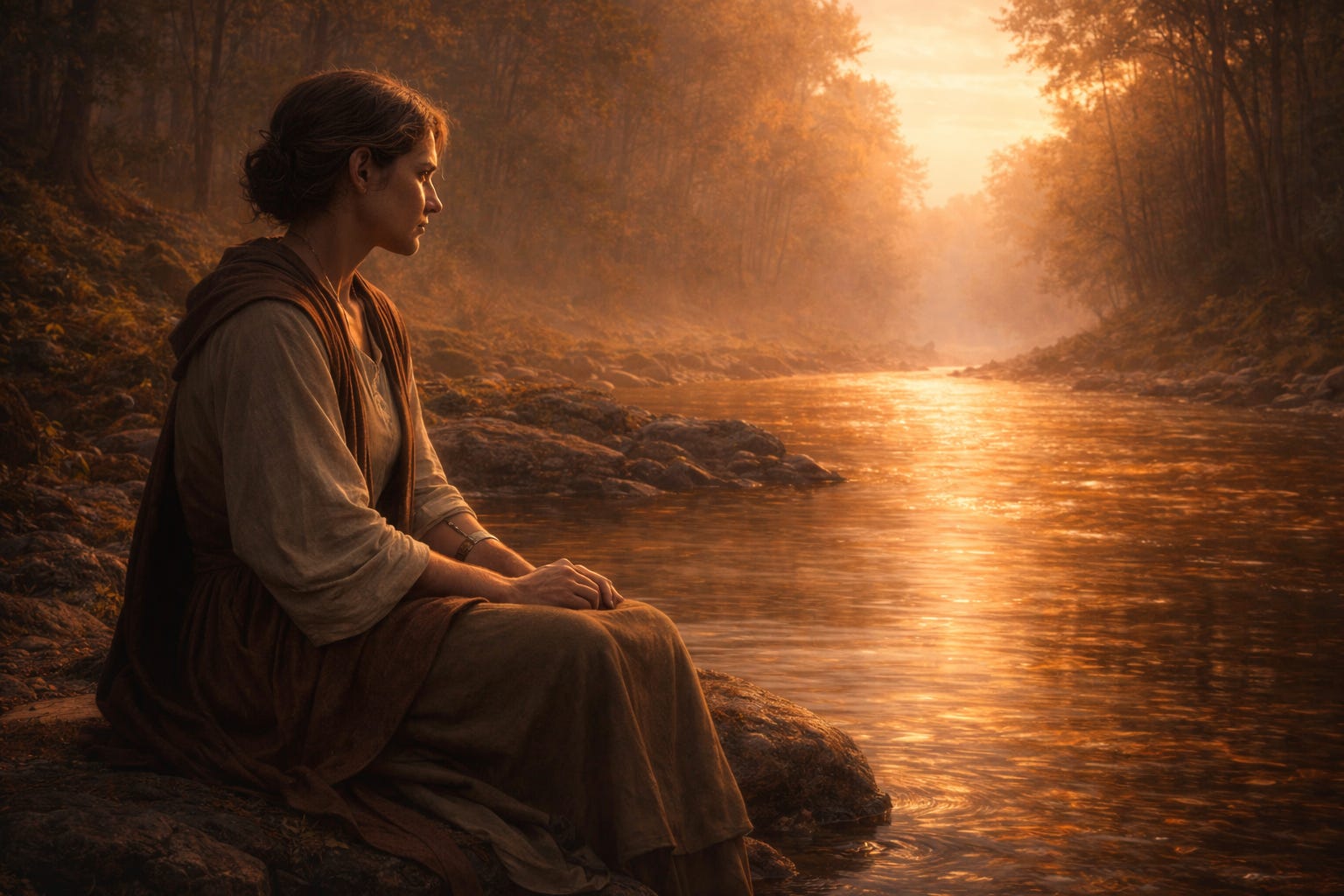
A short distance away, seated upon a smooth stone near the edge of the river, was a woman. He sensed she had been there all along.
She was not adorned as the maiden he met earlier who had given him the emerald stone, nor did she bear the majesty of a queen or the radiance of a goddess. Yet there was something unmistakable in her presence—something composed, attentive, and quietly luminous.
She was neither young nor old in the way one measures such things. Her face bore no mark of distress, and yet it was not untouched by sorrow. Rather, it held the trace of one who had endured much inwardly and had not turned away. She was looking toward the river, listening.
The nameless man did not speak. He did not yet know how.
After a time, she said softly:
“It does not end, does it?”
Her voice did not startle him. It seemed instead to emerge from the same quiet that surrounded them.
He turned his eyes toward the river, then back to her. He did not know what she meant.
She continued:
“I have followed things like this before.
Not this river—but what it carries.”
She paused, as though weighing whether words could hold what she intended.
“Sorrow that is not only sorrow.
Beauty that wounds.
A kind of nearness that does not belong to us.”
The nameless man felt something stir within him—the echo of recognition.

She turned slightly toward him now, her gaze steady.
“You have come a long way with it.”
He looked down at his hands. The emerald stone rested there. She noticed it at once.
“Yes,” she said quietly. “That would do it.”
He lifted his eyes to her, and for the first time, a question formed—not in words, but in need. She answered it as best she could.
“You thought it would give you something,” she said. “Something you could carry… or become.”
She looked again toward the river.
“But it does not work that way.”
He listened. He did not resist her words. He no longer had anything with which to resist.
“It shows you something,” she continued. “And when you try to use it, it withdraws… or breaks you.”
The nameless man closed his hand slightly around the stone. Not to grasp it—but simply to feel that it was still there.
After a long silence, he asked—his voice quiet, unused:
“What is it?”
She did not answer immediately. Not because she did not wish to but because she could not fully say.
“I don’t know,” she said at last.
There was no frustration in her voice. Only honesty.
“I have tried to understand things like it,” she continued. “To name them. To follow their patterns.”
A faint, almost imperceptible smile passed across her face.
“To map them, even.”
She looked at him again.
“Love. Longing. Joy. Loss. They are not separate. They speak to one another beneath everything we feel.”
She lowered her gaze.
“I thought that if I could follow them far enough… I would reach where they come from.”
The river moved quietly beside them.
“But I did not,” she said.
The nameless man felt no disappointment in her words. Only a strange and quiet clarity. He looked again at the stone. Then at the river. Then at her. And something within him—something newly emptied—made space for a different question.
“What if…” he began, though the words came slowly, “what if it is not something to understand?”
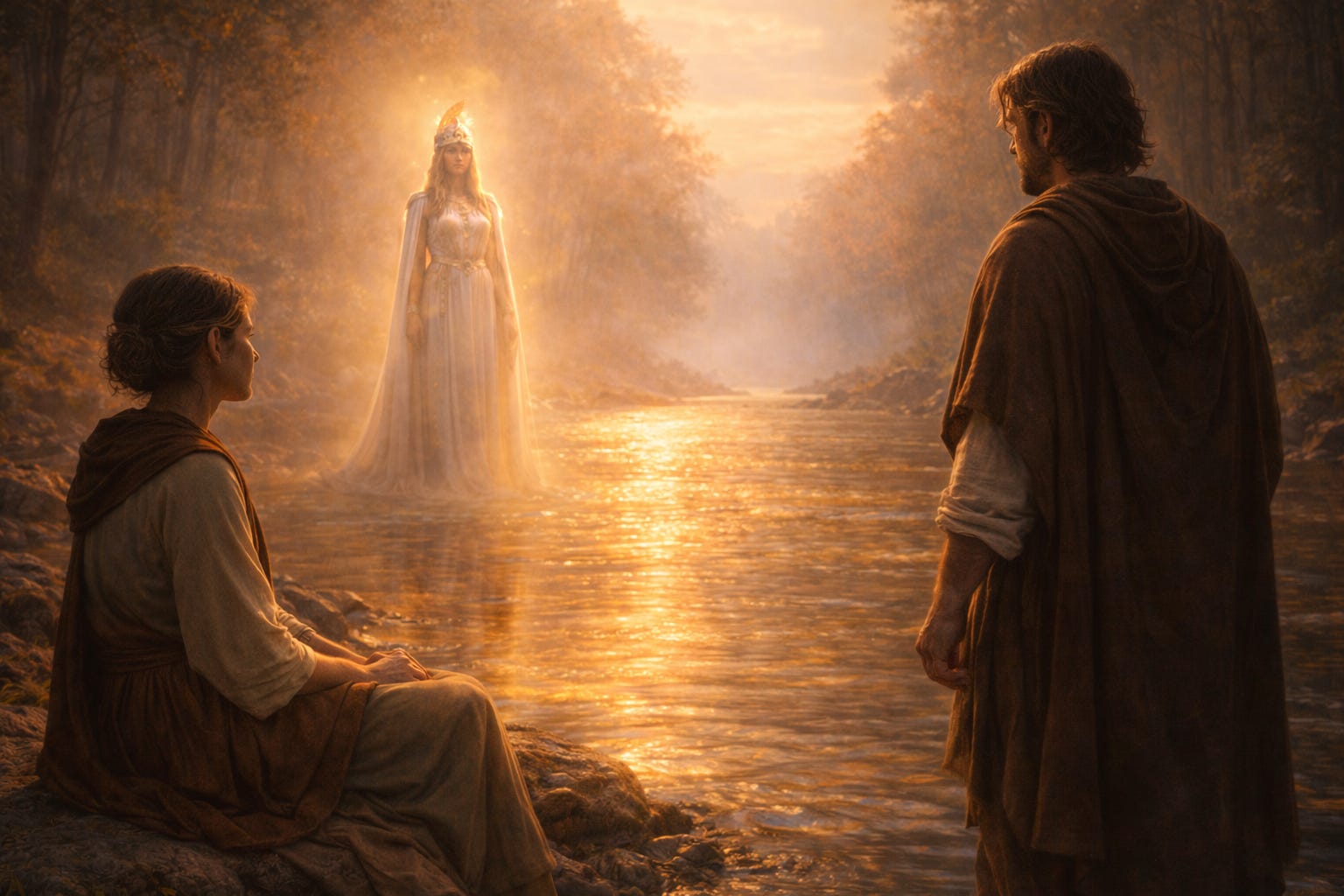
She lifted her eyes to him. Not startled. But attentive in a deeper way.
She continued his thought, uncertain, but compelled:
“You are asking…what if… what if it is not yours?… and it is not mine?”
The words settled between them. Not as an answer. But as an opening.
She did not respond at once. For the first time, her composure shifted—not into confusion, but into something more vulnerable than thought.
She looked toward the river again. But now not as one who listens for patterns. But as one who waits.
“Not mine…” she repeated softly.
The rosy light of Dawn’s throne had begun to gather more fully across the water. The amber current, once dim, now held a quiet radiance—as though something unseen had drawn nearer.
She felt it. She did not name it.
“Then I have been listening…” she said, and did not finish the sentence.
The nameless man did not press her. He could not. He, too, was only beginning.
They remained there together for a time. No longer speaking.
The river moved. The light gathered. And somewhere beyond what either of them could yet perceive—something had begun to approach.
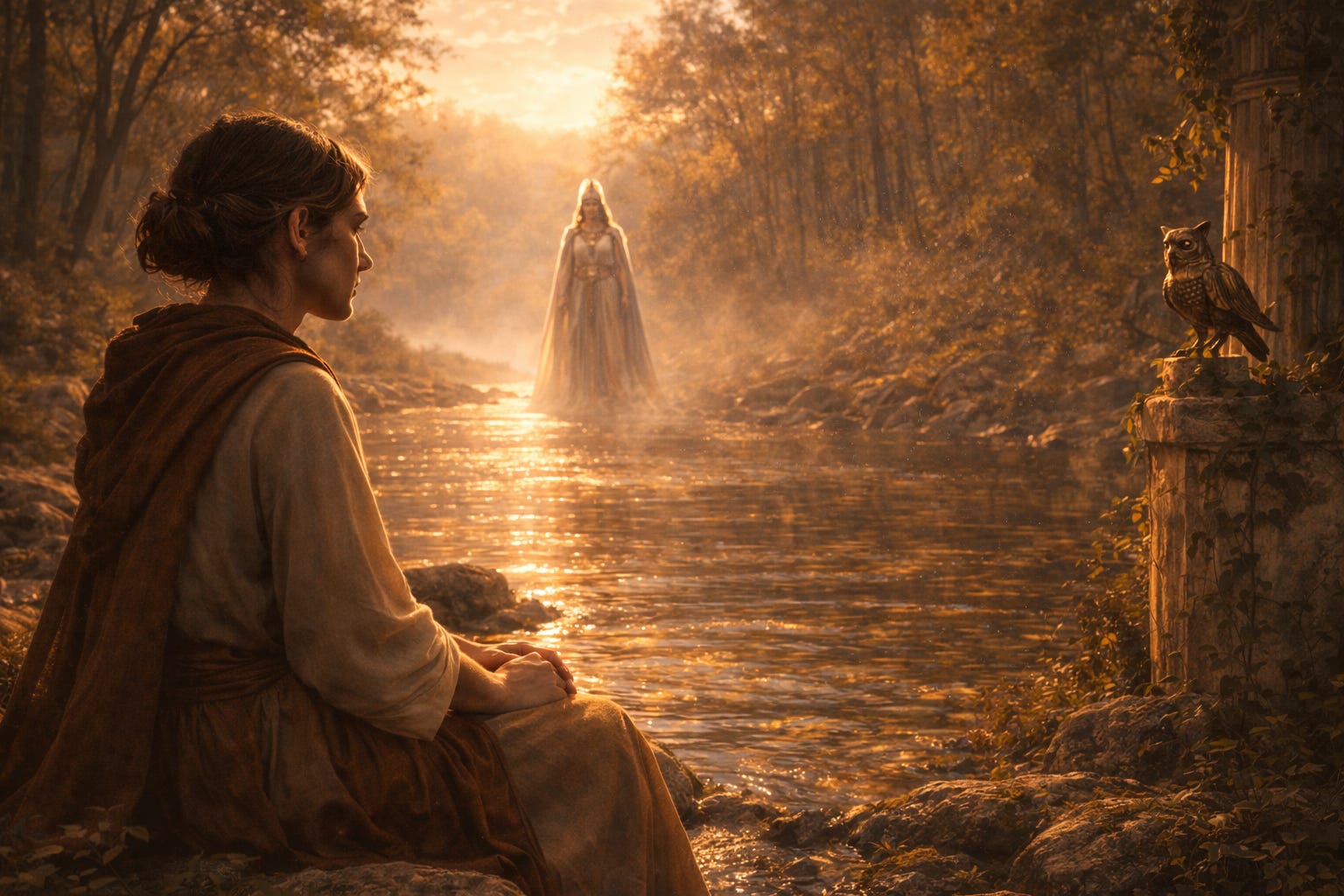
She did not turn back to him because something in her had not yet returned. The river moved as it had before. And yet it no longer seemed to pass. It gathered. Or rather—it allowed something to gather within it.
She watched the amber current, her hands now still at her sides, no longer reaching to touch what she could not hold.
“Not mine…” she repeated, though more quietly now, as if the words were no longer meant to be heard. She had spent so long believing that to listen was to follow—that if one were careful enough, attentive enough, the pattern would yield. That the world, in its subtlety, could be understood.

But this—this did not yield. It did not resist either. It simply…remained.
And in its remaining, it asked nothing of her. That was what unsettled her. Not its mystery but its lack of demand. She had always thought that what was most real would call to her, would draw her forward, would ask something in return.
But this—this neither called nor withdrew.
It did not present itself as something to grasp. Nor as something hidden. It was simply there. And because it was there, she found that she did not know how to approach it.
Her thoughts, once so finely tuned, now moved around it like light around a form that would not cast a shadow. She could not enter it. But she could not leave it either.
“Then I have been listening…” she said again, but the sentence did not complete itself. Because she no longer knew what it meant to listen. Not here. Not now.
Listening, she realized, had always carried with it a quiet assumption—that what is heard belongs, in some way, to the one who hears. That it may be gathered. Interpreted. Held.
But if it is not hers—then what is listening? She felt no answer come. Only a stillness. Something prior. As though something had always been here, waiting to be left unclaimed.
Her gaze softened in release. And for the first time, she did not try to follow the river. She let it be. And in that small, almost imperceptible yielding something in her listening changed. Not into knowledge.
But into nearness.